Harriet Vanger
The Girl with the Dragon TattooHarriet Vanger is the absent center of the Vanger family mystery: a gifted teenager believed to have been murdered in 1966, whose disappearance drives Henrik Vanger to seek an investigation nearly forty years later. She is ultimately revealed to have survived by fleeing Sweden under the identity Harriet Cochran and later appearing as Anita Cochran, while the truth of her ordeal exposes the murderous violence embedded in her family.
Identity and Background
Harriet Vanger was raised in the Vanger family’s tightly controlled world, but Henrik Vanger occupied a uniquely important place in her life. Henrik was childless and contrasted himself with relatives who seemed preoccupied with preserving the Vanger line. Because Gottfried and Isabella Vanger’s marriage deteriorated, Henrik took care of Martin Vanger and Harriet Vanger, regarding them in many ways as the children he had never had. He described Harriet as the apple of his eye and said that she became closer to him than to her parents.
Henrik tried to give Harriet security and self-confidence. Their bond was sufficiently strong that he regarded her as his own daughter, and her disappearance became not merely a family loss but the defining wound of his later life. His attachment also explains why he continued to revisit the case when almost everyone else had accepted that she was dead or abandoned hope of discovering what happened.
Harriet was introverted, like her brother Martin Vanger, but she was also exceptionally intelligent and possessed a clear talent, strong moral sense, and backbone. As a teenager she became deeply involved in religion, distinguishing herself from the rest of the family. Henrik believed that, at fourteen or fifteen, she—not Martin or the family’s mediocre cousins, nieces, and nephews—was destined to run the Vanger business or at least play a central role in it. Her projected future therefore joined personal promise to dynastic expectation: she was both a beloved child and a possible heir to the family’s industrial power.
Disappearance and the Delayed Investigation
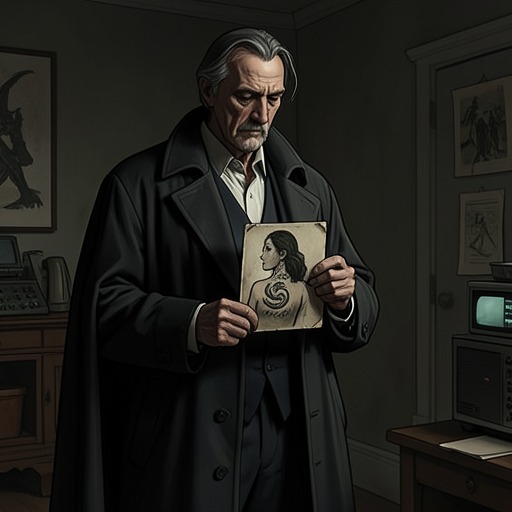
Harriet was last photographed on the day of the Hedeby Bridge Accident while watching a Children’s Day parade on Järnvägsgatan in Hedestad. The image was the first photograph in the 1966 accident photograph album and the last known picture of her. Unlike the other photographs, which showed the bridge disaster, it depicted an apparently ordinary crowd several hours earlier. Its lack of visible drama helped bury its significance, even though Henrik had presumably looked at it countless times as a painful reminder that he would never see Harriet again.
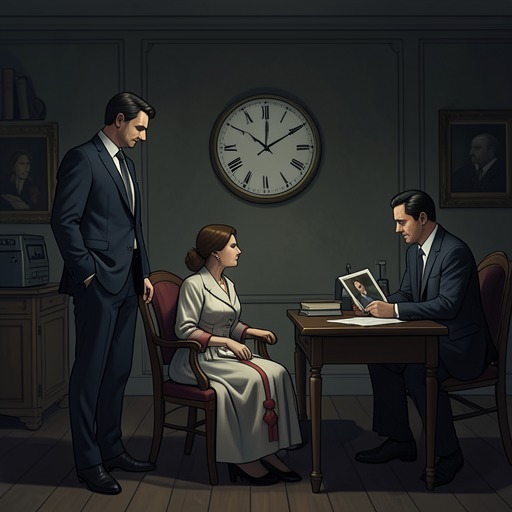
The police investigation was preserved in formal records. Detective Inspector Gustaf Morell arrived by boat at Hedeby Island and took command, preparing a detailed report on Harriet’s disappearance after earlier notes had recorded the developing crisis in abbreviated form. Morell interviewed Henrik Vanger and Isabella Vanger first, then Ulrika Vanger, Harald Vanger, Greger Vanger, Martin Vanger, and Anita Vanger, apparently following a descending scale of perceived importance. The report supplied an official memory of the disappearance, but it did not resolve the family’s private distortions, omissions, or mistaken assumptions.
For almost forty years, Henrik believed that someone in the family had murdered Harriet and that the same person had continued trying to drive him insane. He eventually hired Mikael Blomkvist to determine who had killed her and who had tormented him since the disappearance. The case remained dormant for six months before Blomkvist found three new pieces of the puzzle in the first week of June. His breakthrough began when he suddenly recognized the importance of the parade photograph, which had been overlooked because attention was fixed on the bridge images.
Family Violence and the Threat Behind Her Flight
The investigation gradually connected Harriet’s disappearance with a history of violence against women. Mikael Blomkvist and Lisbeth Salander considered the possibility that the family’s crimes were linked to a sadistic killer, noting that reports of tortured animals and arson appeared alongside several of the murder cases associated with the investigation. The unexplained burning of the parsonage in the late 1970s became one suspicious detail, because fires and animal abuse were treated as possible indicators of a broader pattern rather than isolated incidents.
The murders were traced to Gottfried Vanger’s first series of crimes between 1949 and 1965. Gottfried had involved his son Martin Vanger while Martin was still a teenager: Martin witnessed the murder of Lea in Uddevalla in 1962 at fourteen and took an active part in the murder of Sara in 1964 at sixteen. Mikael concluded that Gottfried had sexually assaulted Martin over a long period and that Martin described this abuse as his duty. The family therefore transmitted violence across generations, not as a simple hereditary fate but through direct instruction, coercion, and abuse.
That history made Harriet’s fear intelligible. Martin was not simply a missing girl’s brother or a powerful family executive; he was connected to the crimes committed by Gottfried and to the continuing threat that Harriet understood more clearly than those around her. Yet Lisbeth rejected any explanation that treated abuse as an excuse for murder. She insisted that Gottfried and Martin had made choices and that mistreatment did not remove their responsibility. Harriet’s story consequently stands within a moral argument about how family trauma can shape violence without determining the actions of either victim or perpetrator.
Escape and Concealed Identity
Harriet did not disappear because she was murdered. On the day of the accident, she was preoccupied with her own danger and was scarcely aware of the bridge disaster that absorbed everyone else’s attention. Martin Vanger had appeared in Hedestad, and Harriet realized that she would never be safe for the rest of her life. She moved between the desire to tell Henrik and the desire to flee, but when Henrik had no time to speak with her, she wandered restlessly through the village.
Her decisive refuge was Anita Vanger. Harriet encountered Anita, who was staying in a guest cottage with Gerda Vanger and Alexander Vanger, and resolved to remain with her. She stayed inside and did not dare go outside, but she knew that she had to take her diary, in which she had written down everything that had happened, together with a few clothes. Anita obtained the clothes for her. The diary became a private record carried out of the family’s immediate reach, while Anita’s assistance turned their relationship into the practical means of Harriet’s escape.
The investigation was delayed by a visual misidentification. Mikael had assumed that Cecilia Vanger was the woman visible in Harriet’s window, but a family photograph from the 1966 council gathering revealed Cecilia beside a second blonde woman in an identical light-coloured dress. The woman was Anita, Cecilia’s younger sister, who was then living in London. Because the sisters looked almost identical and had never previously been seen in the same frame, photographs had made them appear to be one person. The mistaken identity concealed the route by which Harriet had left Sweden.
Harriet eventually lived under the name Anita Cochran and became the mother of Jeff Cochran and two other children. When Mikael reached her, he greeted her in Swedish as Harriet, and the reaction immediately exposed that the name was not forgotten but dangerous. Her son Jeff saw her shock and moved toward Mikael, prepared to protect her before she explained that Mikael was an old friend from the past who had brought problems and bad news.
Return, Disclosure, and Ending
Harriet’s return does not produce a simple restoration of the past. She had spent years terrified that someone would approach her and say her name. When Mikael finally did so, she acknowledged that she had been waiting for such a day since 1966. She also declared that she no longer cared what people thought because the crime she believed herself implicated in fell outside the statute of limitations. Her words reveal that she understood her escape not merely as flight from danger but as an act she feared might be judged as criminal.
The disclosure of Harriet’s survival changes the meaning of Henrik Vanger’s grief and of the archive surrounding her disappearance. The photographs, police report, family chronicle, and private diary had preserved fragments of an event that none of the observers fully understood. The final identification does not erase the decades of fear; it brings the concealed witness back into the story and allows the missing person to speak for herself.
Harriet’s significance lies in the reversal at the heart of her character arc. She begins as an apparently dead heiress whose absence has been converted into a family legend, but she ends as a living woman who chose concealment over submission to a murderous household. Her intelligence, moral seriousness, and independence—qualities Henrik recognized when she was young—survive beneath the assumed identity. Her return exposes the cost of the family’s silence while also demonstrating that survival may require abandoning the name, inheritance, and public identity that others regard as essential.